
Truck space explained
How much fits in a 26-foot moving truck?
A 26-foot label does not establish one universal capacity. Safebound’s measured profile has 1,848 ft³ of physical cargo space; common rental profiles publish up to about 1,700 ft³. Confirm the actual truck and full inventory before relying on either figure.
Why 26-foot trucks have different capacities
The length in a truck's name is only one dimension. Interior width and height, wheel wells, attic space, body construction, door opening, and the way the provider measures cargo space can change usable volume. Two trucks can both be called “26-foot” while publishing different cubic-foot figures.
How to read Safebound's physical ruler
The 1,848 ft³ physical capacity comes from the modeled cargo body and attic. The ruler marks each 100 ft³ through 1,800 ft³, followed by the remaining physical space to the 1,848 ft³ endpoint. It measures occupied cargo space from the front of the truck to the farthest loaded item, including gaps and unused air in that span. This modeled profile is not a certified cargo-capacity promise or a guarantee that a list will fit.
The customer load estimate displays verified occupied truck space in 100 ft³ steps. A span no more than 10 ft³ above a positive step is shown at that step; otherwise it rounds up. A positive load never displays zero. A load near the physical end may display approximately 1,900 ft³. That rounding does not increase truck capacity: the physical ruler and fullness reading use the exact occupied span. For a complete verified load, the advisor separately suggests 100–200 ft³ for packing and practical loading room; any allowance already included in a written quote counts toward that range.
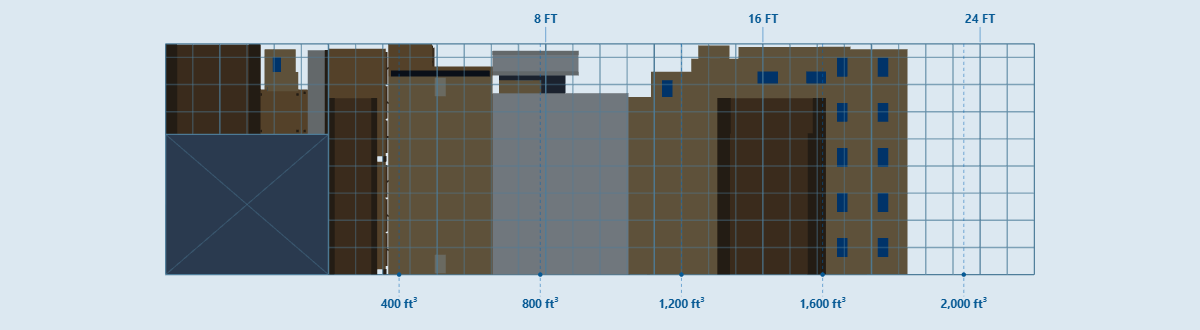
Published 26-foot space comparison
| Profile | Published or displayed space | How to use it |
|---|---|---|
| Safebound measured 26-foot profile | 1,848 ft³ physical capacity; 100 ft³ marks through 1,800 ft³, then the physical endpoint | Use the selected app profile to visualize an inventory. Confirm the actual equipment assigned to the move. |
| U-Haul 26-foot rental truck | 1,682 ft³ | U-Haul labels measurements approximate and says equipment size may vary. |
| Penske 26-foot rental truck | Up to 1,700 ft³ | Penske labels dimensions and capacities approximate and says specifications vary by manufacturer. |
Provider pages were reviewed on September 13, 2026. Verify the dimensions, capacity, payload, and restrictions for the exact truck you reserve or the carrier assigns.
How to check whether your inventory fits
Start with the belongings that will actually move. Space Check uses each catalog item's outside width × depth × height and quantity to build and verify the packed load. Truck space measures the occupied span from the truck front to the farthest loaded item, including gaps and unused air. The headline shows 100 ft³ steps, keeping a positive step when the span exceeds it by no more than 10 ft³ and otherwise rounding up. Choosing a home size gives you a starting list. Your space estimate comes from the items and quantities on that list, so update it to match your belongings.
Then compare the current inventory and pack result with the exact truck assigned to the move. Actual packing, access, payload, protection, and loading method still determine what can be moved safely. Published capacity, physical fit, payload, protection, and a workable loading sequence are different checks. The app visualization supports planning but does not certify a rental truck or guarantee a field load.
How to plan your own 26-foot load
- Build the full inventory. Include storage areas, boxes still to be packed, bulky pieces, and items that will be disassembled.
- Read the total in context. The verified load determines occupied truck space from the front to the farthest loaded item, including gaps and air. The customer estimate uses 100 ft³ steps with a 10 ft³ tolerance above a positive step. Otherwise it rounds that occupied space upward to the next 100 ft³. The physical ruler, exact fullness reading, and truck capacity stay separate from that rounded headline. A home-size starter follows the same rule.
- Select the matching truck profile. Use the rental profile for a typical rental comparison and the measured Safebound profile when that is the equipment being discussed.
- Inspect the load view. Cubic feet alone cannot show every geometry or loading constraint.
- Leave practical moving room. For a complete verified load, consider the separate 100–200 ft³ advisor allowance and count any space already included in the written quote. Confirm protection, access, payload, equipment, and loading decisions with the mover or rental provider.