
Free moving inventory and space planner
Estimate your moving space in cubic feet.
List the belongings you plan to move. Review their estimated space in a 3D truck preview.
Public guide · interactive Build and Truck require a Safebound account
How the moving space calculator works
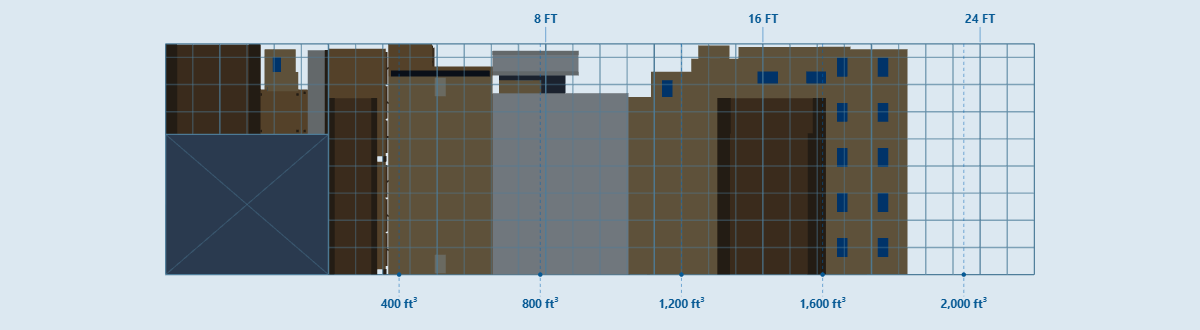
Build a list of the belongings that are actually moving. Space Check arranges representative catalog items in a 3D truck preview. After the complete load is verified, estimated truck space runs from the front of the truck to the farthest loaded item, including gaps and unused air. Review your items and quantities before using that planning estimate.
The useful question is not “How big is my home?” It is “Which belongings are actually moving, how many are there, and what representative transport dimensions are being used?” The calculator keeps those inputs visible through three steps.
List what is moving
Add furniture, appliances, and boxes from the catalog room by room. Confirm the closest catalog match for items read from a quote or photo. Quantities matter more than a bedroom-count shortcut.
Review the planning total
Item lines use representative outside dimensions and quantities. The headline uses the verified packed truck span, shown in 100 cubic feet steps: a span no more than 10 cubic feet past a positive step is shown at that step; otherwise it rounds up. Starters and custom lists use the same rule. If any items remain outside the truck, the shown space covers only the loaded portion and full-load planning guidance stays unavailable.
Inspect the truck
The 3D view plans the load inside a truck. It is a planning visualization, not a promise that a real crew will stack every piece the same way.
What the result means—and what it does not
| Result | Useful for | Do not treat it as |
|---|---|---|
| Item count | Reviewing whether the selected catalog list reflects what is moving | Proof that every small or unusual item was included |
| Planning cubic feet | Reviewing the verified packed truck span, including gaps, shown in 100 cubic feet steps | A physical survey or certified measurement of the loaded shipment |
| Truck-fit view | Seeing how the selected inventory may be arranged in the chosen truck | A guaranteed loading sequence, capacity certification, or final price |
| One-quote space check | Placing one quote's stated cubic feet beside the confirmed inventory's planning total | An automatic review of services, contract terms, legality, or intent |
Why bedroom count is not a cubic-foot formula
Two three-bedroom homes can have very different inventories. A starter can help you begin, but its label does not dictate a volume: the selected items and quantities use the same verified packing calculation as a custom list. Review the complete inventory and the estimated truck space, rather than relying on bedroom count.
Add or remove every item and quantity that differs, including storage, garage, outdoor, oversized, and still-unpacked belongings. Confirm the current list and written scope with the mover.
See how Safebound's measured 26-foot profile compares with published rental-truck space.
How to get a more useful estimate
- Count the actual goods. Include storage areas, wall art, garage items, outdoor furniture, and boxes you still expect to pack.
- Do not force an unusual item into a rough match. Oversized sectionals, safes, gym equipment, antiques, and custom furniture deserve written dimensions and a professional survey rather than blind reliance on the nearest representative catalog dimensions.
- Match the same scope. Compare quotes only after confirming packing, storage, stairs, elevators, long carries, shuttles, bulky items, and valuation coverage.
- Ask for the survey. For interstate household-goods moves, federal rules generally require the written estimate to be based on a physical survey unless the customer waives it in writing.
Sources and methodology
We separate the calculator's own assumptions from the rules governing a mover's written estimate. The primary references below explain the survey and consumer-protection requirements; our methodology page documents representative catalog dimensions, packed truck space, display rounding, and quote-check boundaries.