
Moving quote comparison
Compare moving quotes against the same move.
Compare written estimates with source references in Quote Library, or use the four-quote worksheet for a fully manual review.
Public guide · Quote Library and Check require a Safebound account · manual worksheet stays public
The fields that make two moving quotes comparable
Price belongs at the end of the comparison, not the beginning. Start by checking whether each mover is pricing the same job.
| Compare | Questions to ask | Why a mismatch matters |
|---|---|---|
| Inventory | Are the same furniture pieces, appliances, boxes, and quantities listed? | An omitted item can lower the written total before moving day. |
| Shipment basis | Is the price based on weight, cubic feet, or hourly labor? What quantity is stated? | A 700-cubic-foot quote and a 5,000-pound quote are not directly comparable without the assumptions behind each. |
| Estimate terms | For an interstate move, is the estimate binding or non-binding? Does the document add any not-to-exceed promise? | Federal Part 375 defines binding and non-binding estimates; any separate ceiling depends on its wording and governing law. |
| Services | Are packing, materials, disassembly, storage, shuttle, stairs, elevators, and long carries included? | A low base price can exclude work another quote already includes. |
| Liability choice | What carrier-liability option is shown, and what did you select? | Different protection choices can change both price and risk. |
| Pickup and delivery | Are dates firm, estimated, or a window? Who is the performing carrier? | Different timing and carrier arrangements are different offers. |
Use the live four-quote worksheet
The free worksheet puts four written estimates into one field-by-field view. It covers company role, estimate type, route, pricing basis, inventory, labor, packing, access, storage, liability choice, timing, payment, cancellation terms, and line-item totals.
Use Save on this device to keep worksheet entries in this browser, export a separate worksheet backup, or print a copy. Import shows a preview before replacing the whole worksheet. This manual page does not upload or automatically analyze quote documents.
Is my moving quote's cubic footage too low?
Quick answer: A quoted cubic-foot total is enough only when it represents the same complete inventory and written scope and leaves practical moving room. A lower figure is a question to reconcile, not proof of fraud, intent, or an omitted item.
A lower cubic-foot figure is a reason to compare the details of the move. Start with the belongings and quantities on the written estimate, including boxes you still need to pack, storage areas, and unusually large items. Compare that same list with your Space Check plan, then ask the mover to explain any difference in writing. Also confirm packing, disassembly, access, storage, and other included services.
Space Check gives you an approximate modeled total and a visual reference; real dimensions and loading conditions vary. Leave room for practical moving needs and have the mover confirm the complete inventory and written estimate before moving day.
Historical 1,432-versus-1,700 ft³ interface illustration
This screenshot records an earlier starter list, catalog, and planning-volume method. It remains useful for showing how the interface places a written quote marker beside a planning ruler, but 1,700 ft³ is not a current three-bedroom benchmark and the image does not establish the current inventory total.
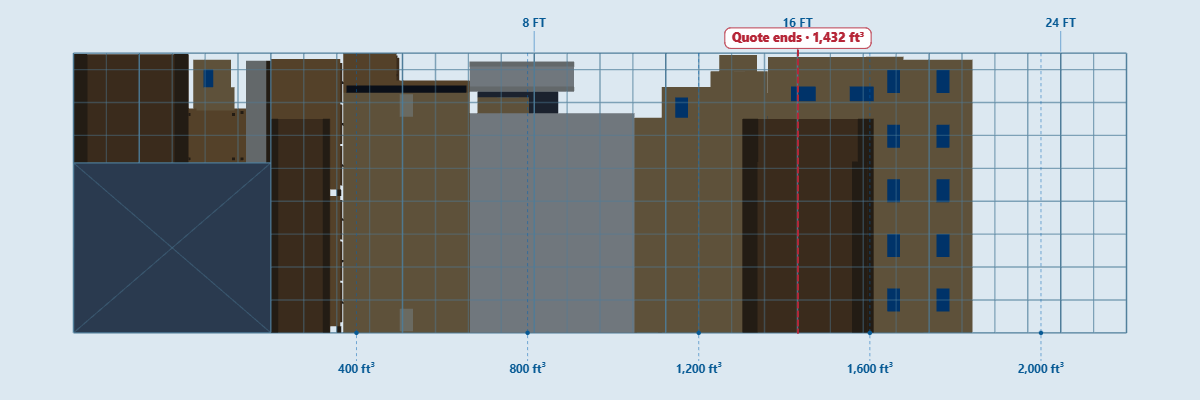
For a current comparison, confirm the items and quantities first. After verifying the packed load, Space Check measures truck space from the front of the truck to the farthest loaded item, including gaps and unused air within that span. It displays that space in 100 ft³ steps: a span no more than 10 ft³ above a positive step is shown at that step; otherwise it rounds up. A positive load never displays zero. Item volumes remain separate, and physical fullness for Safebound’s measured 26-foot profile uses the exact occupied span rather than the rounded headline. If items remain outside the truck, the shown span covers only the loaded portion. Compare the quote against the same full inventory and ask what packing, services, and space basis produced the written figure. Read the current calculation method.
What the one-quote space check does
The live checker reads inventory rows and a stated cubic-foot total from one uploaded or pasted quote, asks you to confirm the catalog matches and quantities, calculates the confirmed list's planning total, and places the two space numbers side by side. You can also enter one quote's cubic feet manually.
Quote inventory extraction
Item lines from the document are mapped to the catalog for your review. An unmatched line is an extraction issue to resolve, not proof the mover omitted an item.
Confirmed planning total
Your approved catalog matches and quantities produce the same approximate planning total used throughout the app.
Visible space difference
The quote's stated cubic feet are placed beside the confirmed list's planning total, with the difference and estimated coverage shown in plain language.
Questions for the mover
Use the comparison findings, manual checklist, and guides to investigate inventory, services, estimate type, liability, dates, payment, and contract terms.
Compare original documents in Quote Library
Quote Library keeps written estimates together for review. You can:
- add written estimate documents and review the details read from each source;
- check extracted fields against the original document before relying on them;
- select quotes for a side-by-side comparison with source references beside the findings;
- keep missing, ambiguous, or conflicting terms visible as questions to confirm;
- export a move plan backup for safekeeping.
The comparison summarizes disclosed differences; it does not replace the original quote or written agreement. The standalone worksheet is a separate manual, device-only page and does not upload or analyze documents. Any online document processing presents its own disclosure before sending.
Primary consumer-protection references
- FMCSA Protect Your Move
- FMCSA — Consumer Rights and Responsibilities
- 49 CFR § 375.401 — written estimates and surveys
- 49 CFR § 375.407 — payment at delivery for non-binding estimates
For the federal distinction between binding and non-binding interstate estimates—and why other not-to-exceed wording must be read in context—see the moving estimate types guide.